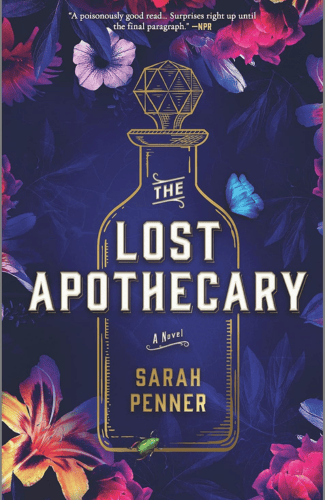
The Lost Apothecary

by Sarah Penner

View All Books

Summary

A female apothecary secretly dispenses poisons to liberate women from the men who have wronged them – setting three lives across centuries on a dangerous collision course.

Rule #1: The poison must never be used to harm another woman.
Rule #2: The names of the murderer and her victim must be recorded in the apothecary’s register.

One cold February evening in 1791, at the back of a dark London alley in a hidden apothecary shop, Nella awaits her newest customer. Once a respected healer, Nella now uses her knowledge for a darker purpose – selling well-disguised poisons to desperate women who would kill to be free of the men in their lives. But when her new patron turns out to be a precocious twelve-year-old named Eliza Fanning, an unexpected friendship sets in motion a string of events that jeopardizes Nella’s world and threatens to expose the many women whose names are written in her register.

In present-day London, aspiring historian Caroline Parcewell spends her tenth wedding anniversary alone, reeling from the discovery of her husband’s infidelity. When she finds an old apothecary vial near the River Thames, she can’t resist investigating, only to realize she’s found a link to the unsolved “apothecary murders” that haunted London over two centuries ago. As she deepens her search, Caroline’s life collides with Nella’s and Eliza’s in a stunning twist of fate – and not everyone will survive.

[summary provided by GoodReads]

GoodReads Nominee for Favorite Historical Fiction 2021, and Nominee for Favorite Debut Novel 2021

Published:
Genre:
Subgenre:
Format:
Narration:
GoodReads:3.76
My Score:
Spice:None

My Review

This was my first time reading a book by this author, and while I found aspects of the story intriguing, particularly the overarching mystery and historical elements, it ultimately didn’t live up to my expectations.

The dual timeline structure, moving between the present day and the 1700s, made it difficult for me to fully immerse myself in either storyline. Just as I was becoming engaged in one time period, the narrative would abruptly shift, which felt jarring and disrupted the pacing. This back-and-forth made the story feel somewhat disjointed and prevented me from truly connecting with the characters.

Interestingly, I found the 18th-century timeline far more compelling than the present-day one. The historical setting and characters were rich and engaging, and I often wished the entire book had focused solely on that era. In contrast, the modern timeline felt less necessary and, at times, detracted from the overall impact of the story.

While I appreciate the author’s skill in crafting a layered narrative, this particular book just didn’t resonate with me. That said, I did enjoy certain elements and can see how others might connect with it more than I did. I’m still open to exploring more of this author’s work—perhaps this just wasn’t the right starting point for me.

If the premise sounds intriguing to you, I’d still recommend giving it a try; you might have a different experience.