The Hating Game
by Sally Thorne
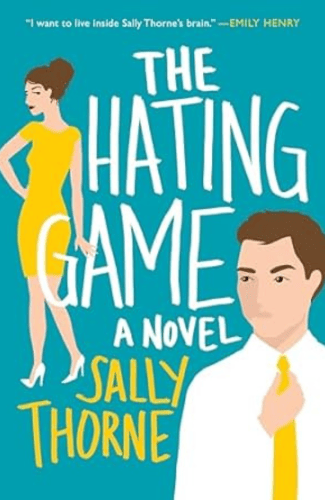
Summary
Nemesis (n.) 1) An opponent or rival whom a person cannot best or overcome.
2) A person’s undoing
3) Joshua Templeman
Lucy Hutton has always been certain that the nice girl can get the corner office. She’s charming and accommodating and prides herself on being loved by everyone at Bexley & Gamin. Everyone except for coldly efficient, impeccably attired, physically intimidating Joshua Templeman. And the feeling is mutual.
Trapped in a shared office together 40 (OK, 50 or 60) hours a week, they’ve become entrenched in an addictive, ridiculous, never-ending game of one-upmanship. There’s the Staring Game. The Mirror Game. The HR Game. Lucy can’t let Joshua beat her at anything—especially when a huge new promotion goes up for the taking.
If Lucy wins this game, she’ll be Joshua’s boss. If she loses, she’ll resign. So why is she suddenly having steamy dreams about Joshua, and dressing for work like she’s got a hot date? After a perfectly innocent elevator ride ends with an earth-shattering kiss, Lucy starts to wonder whether she’s got Joshua Templeman all wrong.
Maybe Lucy Hutton doesn’t hate Joshua Templeman. And maybe, he doesn’t hate her either. Or maybe this is just another game.
GoodReads Nominee for Favorite Romance 2016
My Review
I gave this audiobook a listen. The narrator did a commendable job, though I found the character voices lacked distinctiveness, making it a bit challenging to instantly discern who was speaking. More variation in the voices could have enhanced the experience, but on the whole, it was a decent audio rendition.
Regarding the story, quite a few aspects didn’t sit well with me. Despite the hype surrounding the book, I struggled to grasp its appeal. Admittedly, the writing is engaging and enjoyable, which I can see why people appreciate it. However, labeling it as a true enemies-to-lovers romantic comedy feels misleading since neither character harbors genuine animosity toward the other. This aspect left me feeling disappointed. Additionally, I found both characters to be grating, cringe-worthy, and lacking depth. The juvenile and monotonous nature of their interactions only enhanced my frustration. Moreover, the narrative felt overly prolonged, testing my patience as it dragged on. By the end, I was ready for it to be over and found myself skipping through parts of the audiobook out of sheer disinterest.
One of the major issues for me revolved around Lucy’s constant fixation on her petite stature throughout the entire book. It became repetitive and distracting—alright, we get it, she’s small, can we please move on? Furthermore, her dynamic with Joshua felt more driven by lust than genuine love, which was frustrating. What bothered me the most, though, was Lucy’s inconsistent behavior. She’d daydream about being intimate with him, yet when the opportunity arose, she’d pull back, sending mixed signals. It left me questioning her intentions—did she truly want him or not? Her indecisiveness and immature actions made it difficult to sympathize with her character.
Joshua didn’t fare much better in terms of likability. Perhaps if we had his perspective, the book would have been more compelling, but he came across as smug, arrogant, manipulative, and toxic. It felt like he was constantly hiding his true emotions and engaging in behaviors to avoid confronting them—a trait common among younger characters, but nonetheless frustrating to witness.
It’s no secret how predictable the storyline is, with the clear indication that they don’t actually despise each other but desire to be together. While this lack of surprise wasn’t unexpected, the manner in which the narrative unfolded to reach that point was disappointingly executed.
There is language in this book along with some steamy kissing scenes and one spicy scene toward the end. I skipped past that part because I prefer closed-door romances.
I picked up this book out of curiosity about the movie adaptation. Reading the book before watching the film, I found the movie to be better, mainly because the characters felt more tolerable and less irritating on screen. Although there were some differences between the two versions, the movie remained largely faithful to the source material. Overall, I found much more enjoyment in the movie than in the book. If you’ve already seen the movie, I’d suggest skipping the book, as it doesn’t add much to the experience.
Overall, I found certain aspects of the story enjoyable. The banter between the characters was engaging, although it did become grating at times. A highlight for me was the section where Lucy falls ill and Joshua steps up to care for her—it was genuinely heartwarming. While the ending was predictable, it still managed to be satisfying, with the final grand gesture leaving a positive impression.
I’d suggest giving the movie a watch, but I wouldn’t recommend the book. As for reading more from this author, I don’t think I will — her writing style is not a good fit for me.
More Books by Sally Thorne