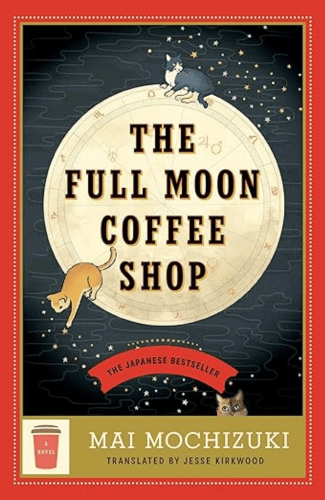
Book Summary
In Japan, cats are a symbol of good luck. As the myth goes, if you are kind to them, they’ll one day return the favor. And if you are kind to the right cat, you might just find yourself invited to a mysterious coffee shop under a glittering Kyoto moon. This particular coffee shop is like no other. It has no fixed location, no fixed hours, and seemingly appears at random to adrift young people at crucial junctions in their lives.
It’s also run by talking cats.
While customers at the Full Moon Coffee Shop partake in cakes, coffees, and teas, the cats also consult them on their star charts, offer cryptic wisdom, and let them know where their lives have veered off course—because every person who visits the shop has been feeling more than a little lost. And for a down-on-her-luck screenwriter, a romantically stuck movie director, a hopeful hairstylist, and a technologically challenged website designer, the feline guides will set them back on their fated paths. After all, there is a reason the shop appeared to each of them…
My Thoughts
My husband is of Japanese descent and has a deep appreciation for his cultural roots. Over the years, he’s immersed me in Japanese culture as well, especially through countless hours of watching Japanese YouTubers. Because of that, I’ve developed a real fondness for the country and its people. Japan is now one of my top travel destinations, so when I came across this book, I was immediately intrigued by the summary. I’m always eager to learn more about Japanese culture, especially through fiction.
That said, this story wasn’t quite my cup of (green) tea.
I was expecting a cozy fantasy or magical realism novel, but the story took an unexpected and, for me, overly bizarre turn. At times, I struggled to follow the plot and found myself confused by what was happening. The magical cats, who stand upright, wear clothes or accessories, serve food and drinks, and offer wisdom based on astrology, felt more surreal than whimsical. Since astrology has never really interested me, I ended up skipping over parts related to birth charts and signs.
It’s possible that my unfamiliarity with Japanese mythology and folklore contributed to my disconnect from the story. I appreciated the attempt to weave in cultural elements, but they didn’t fully land for me. The book is divided into different parts, each following a new character, but unfortunately, I didn’t feel invested in any of them. Months later, I honestly don’t remember much about the plot or the characters, which says a lot about how little it resonated with me.
That said, I did enjoy the cozy moments—the detailed descriptions of food and beverages were delightful, and the overall atmosphere had a certain charm that reminded me of cozy fantasy settings I usually enjoy.
Ultimately, this book wasn’t a fit for me, but I can see how others might enjoy it, especially if they’re more familiar with Japanese lore or have an interest in astrology and birth charts. If the premise piques your interest, it’s worth giving a try—it’s a quick, quirky read that might be just your style.